

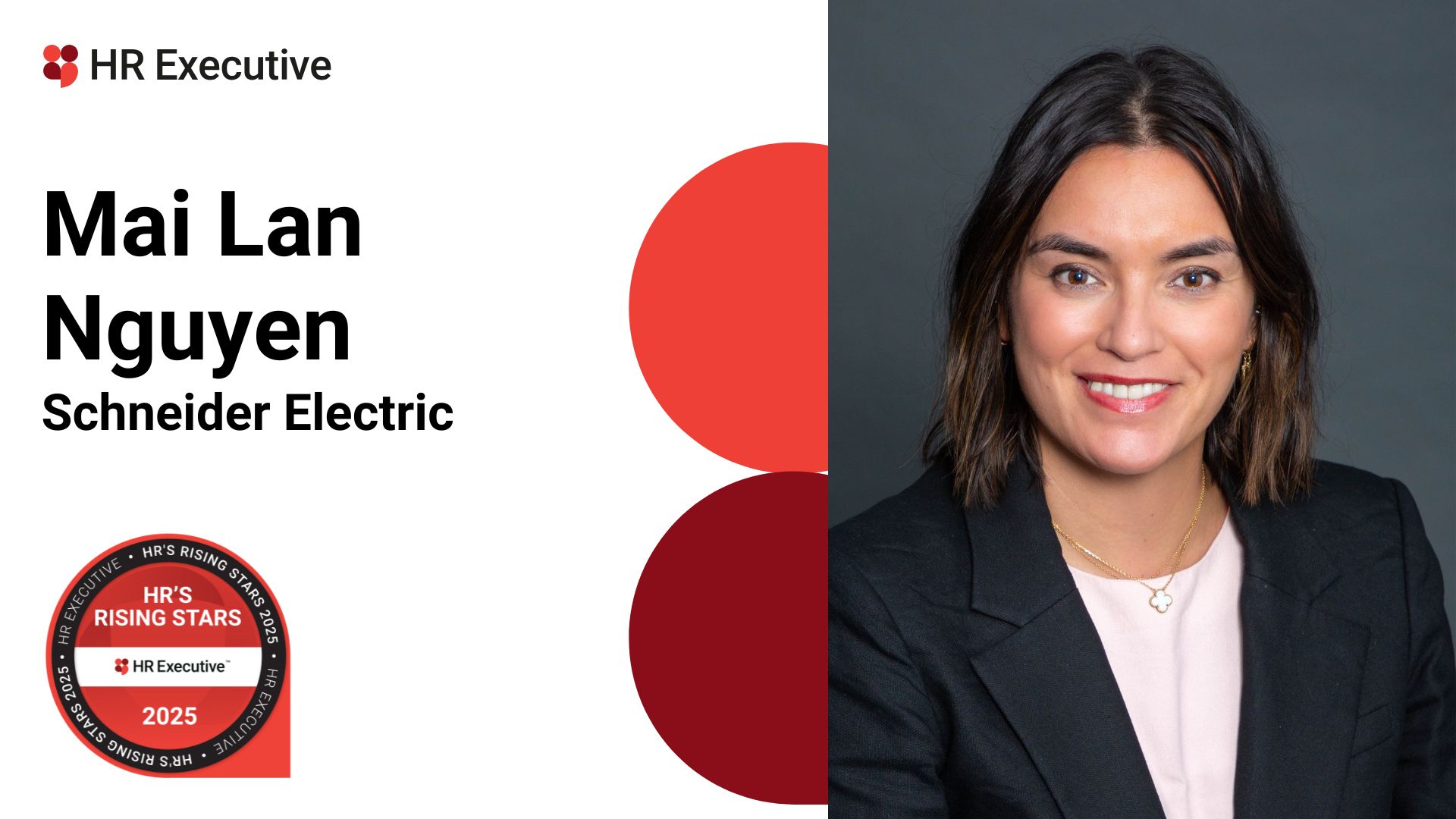
In her tenure with Schneider Electric, Mai Lan Nguyen has held a range of HR positions around the globe—from directing talent development and performance management initiatives in Paris and later, Shanghai, China, to heading the HR operation for South America, based in São Paulo. For the last seven years, she has helmed HR for North America, now in Boston.
Her 21-year journey with Schneider is one that Nguyen, one of this year’s HR’s Rising Stars winners, says reflects the company’s deep commitment to developing lasting opportunities for all employees, as its talent function increasingly becomes a strategic driver of business success.
Related: Meet all of 2025 HR’s Rising Stars
“HR has always been a very strong partner to the business at Schneider,” she says. “In the last few years here, I’ve really seen the HR function become a force multiplier for innovation, trust and operational excellence.”
Developing Schneider Electric’s 40,000 North American employees has been a core focus for Nguyen.
For instance, she is credited with securing leadership approval for Coursera licensing company-wide and for becoming a leading voice shaping Schneider’s approach to AI upskilling.
The AI Upskilling at Scale Program guides all employees along their respective AI journey, from basic to advanced users, with learning that is tailored to roles and functions.
See also: To maximize AI training, build ‘habits, not checklists’
“Our learning platforms are AI-enabled,” Nguyen adds. “Based on what you believe your skills gaps are, it’s going to push the right type of training for you.”
AI upskilling is a “massive” priority, she says, for Schneider’s North American workforce and a “great enabler” for both employees and, ultimately, customers. Nguyen is modeling AI adoption through her own use of an AI coach as part of a pilot extended to a share of company leaders.
“I’m part of those lucky [participants], and I’ve been blown away by the potential of AI-powered coaching,” she says. “It gives you a lot of insights and feedback.”
AI is also a foundational element of Schneider’s Open Talent Marketplace, an internal mobility platform that Nguyen spearheaded. Rolled out in 2020, the career development platform gives workers access to new roles, project work, mentorship opportunities and learning recommendations customized to their skills and goals.
Talent development and an internal marketplace
The marketplace’s impact is demonstrable: Ninety-two percent of North American employees are enrolled, with postings of about 7,000 jobs and nearly 500 internal gig opportunities. Meanwhile, employees have made 6,200 mentorship matches.
The platform is credited with driving internal mobility up by 35% while simultaneously reducing hiring costs.
Although the technology powering the platform is integral to its success, just as critical has been the change-management work to support the initiative, Nguyen says.
For instance, employees aren’t required to seek manager approval to apply for a new role or gig. That element has meant managers need to be coached to keep feedback continuous and ensure they understand where their reports are and where they want to head.
“That can be quite complicated to manage, especially when you’re a big company and you’re now saying, ‘We really want to empower people to own their career,’ ” Nguyen says. “You have to really walk the talk.”
While the marketplace is “open” by design, there are stated rules around how much time employees can dedicate to a project and when they can move from one project to the next.
“Like anything,” Nguyen says, “it had to start with a pilot, we experimented, and then we learned from the usage and made quick changes. That’s how you need to stay agile and resilient, and that’s the way I want to continue to operate in HR with my team.”
A broadened lens on talent
While agility is key to Nguyen’s approach to HR innovation, it is supported by a commitment to inclusion.
“One of the [elements] that has kept me at Schneider Electric for so long is how diverse we are,” she says. “But you can have a lot of diversity and if you don’t have the right inclusive behavior, you can’t make the most out of that.”
Nguyen has embedded inclusion into the organization’s approach to building out the talent pipeline. In 2022, she rolled out a Returnship Program to support professionals re-entering the workforce. For six months, cohorts receive mentorship, training and upskilling, with 48 individuals having completed the program—with a 100% retention rate and 85% conversion to full-time employment with Schneider.
Under her leadership, Schneider has also broadened its support for veterans—such as through 67 fellowships offered in partnership with the Department of Defense’s SkillBridge initiative; veteran hiring now exceeds 7%, well above the federal benchmark.
Connecting talent, training and inclusion
Nguyen has also forged deeper connections with organizations, including the Society of Women Engineers, National Society of Black Engineers and Society of Hispanic Professional Engineers.
She is the developer of a leadership training program called Inclusion for Impact—providing coaching, gamified simulations, workshops and more designed to drive inclusive environments. The focus on areas like nondiscrimination and psychological safety equips mid-level managers, she says, with the tools for equitable decision-making and inclusive leadership.
More than 400 leaders have participated, she notes, and their teams report better engagement and business outcomes compared to those who have not yet been trained.
“There is a way to measure success and impact” of inclusion initiatives, she says, but it takes time, continued investment and top-level leadership, noting that “inclusion” is one of the company’s six core values—alongside mastery, purpose, action, curiosity and teamwork. “It doesn’t happen overnight. You need to make sure the business is solidly behind you.”
Flexibility as a key driver of employee wellbeing
Another area where Schneider has fully invested in its workforce is employee wellbeing, Nguyen says, another space where she has led innovation.
For instance, she masterminded a Part-Time Program designed to help enable caregivers to meet both personal and professional needs and, in 2022, rolled out Recharge Breaks—a program that enables employees to take an up-to-12-week paid sabbatical.
“Wellbeing is part of building high-performing teams. You can’t sustain high performance unless you recharge,” she says, pointing to elite athletes who strategically leverage rest to drive performance.
So far, more than 800 U.S. and Canadian employees have taken or plan to take their Recharge Break.
“They come back engaged because they’ve done these once-in-a-lifetime things they had on their bucket lists, and we were able to plan for the break as a company,” she says. “They come back super grateful, super engaged and able to bring their best self to work.”
The program is among those Nguyen has engineered that contribute to impressive talent gains: Voluntary turnover now sits at under 4%, while engagement scores are at a record high, ranging from 2 to 8 points above global benchmarks. This year, the organization ranked 11th on Glassdoor’s Best Places to Work list.
“I’ve seen Schneider make some huge changes in the way we build our benefits and our employee experience,” she says, “that have completely changed the game.”
Deepening the Schneider culture
Some of Nguyen’s most innovative work—including Recharge Breaks and the Open Talent Market—germinated in the leadership forum she leads. Called the HR Council, the group brings together leaders to align talent and business strategies.
Another effort born through the Council is the One Team cultural initiative. Initially deployed in HR, One Team is now a “company-wide movement” that equips leaders and managers with toolkits, behavior guides and more to fuel more effective, cross-functional teamwork.
The project was a recognition that the company could benefit from fewer silos, more collaboration and more “honest conversation across teams,” especially in a “very matrixed, complex environment,” Nguyen says.
One Team is now “not just an enabler for business value,” she says, “but it’s really the North Star of how we come together to create value for our customers and make a difference in creating a more sustainable, efficient, reliable world in the space of energy management and digital automation.”
How employees’ ‘great ideas’ help drive decisions
To further the One Team culture work, Nguyen led Schneider’s hybrid work transformation, coined Return to People, which supports the organization’s post-COVID policy of encouraging employees to work two to three days in the office.
“Return to People isn’t about returning to the office but really about maintaining a culture that is a differentiator,” she says. “It’s about making sure people feel like they are contributing to something bigger than themselves, creating those spaces that are really the extension of your culture.”
It’s work that was directly influenced by employees. Nguyen undertook a listening tour before designing the model, finding that 83% of employees preferred hybrid work.
“I’m always in awe of the great ideas people have around you,” she says. “Our job as leaders is to make sure we listen—listen to understand—and make sure we give people the space to do what they do best.”
Taking ‘my seat at the table’
Giving employees a voice reflects Nguyen’s belief that true HR leadership hinges on two critical capabilities: strong business acumen and empathy.
It connects back to what an early supervisor told her when she joined Schneider Electric: Leaders at the organization approach their work with both the “heart and mind.”
“Empathy is the way I see us being much more in tune with what our people are going through. If we want them to thrive and actually solve problems for our customers, we really do have to craft the right employee experience,” she says.
‘Just the beginning’ for this inspiring leader
That people-centered mindset about leadership shone through to the Rising Stars judges, says Xan Daniels, vice president of inclusion, diversity and employee engagement at Alight Solutions. Daniels, a 2024 HR’s Rising Stars winner and one of this year’s judges, calls Nguyen a “shining example of what it means to lead with both vision and heart.”
“From championing inclusive innovation through the Open Talent Marketplace to creating pathways back to work and fostering a culture of belonging, her work has touched every corner of the organization,” Daniels says. “She has shown that when HR leads with empathy and boldness, it becomes a catalyst for growth and connection.”
Daniels calls Nguyen’s journey “an inspiration,” noting, “and it’s only just the beginning.”
Looking to the future, Nguyen says she’s eager to continue tackling business problems with data-driven storytelling that aims to remove obstacles to employee success—ultimately, positioning the HR function as a strategic contributor to the business and to the lives of employees.
“I don’t want HR people to say, ‘I need to earn my seat at the table.’ Just take it and be there; don’t second-guess it.”
Nguyen and the other 2025 HR’s Rising Stars will be honored during the inaugural HR Icons Awards Evening, taking place Sept. 15 at Mandalay Bay in Las Vegas as part of the HR Tech conference.