


Close Menu
Human Resources Mag
  • Home
  • News
  • Management
  • Guides
  • Law
  • Talents
  • Benfits
  • Technology
  • More
    • Web Stories
    • Editor’s Picks
    • Press Release
What's On
Alberta appeal panel upholds PTSD claim over threat of sexual violence at work

Alberta appeal panel upholds PTSD claim over threat of sexual violence at work

December 12, 2025
Dec. 12: New leaves take effect

Dec. 12: New leaves take effect

December 11, 2025
Quebec court draws hard line between legal and illegal employee monitoring

Quebec court draws hard line between legal and illegal employee monitoring

December 11, 2025
Facebook X (Twitter) Instagram
Human Resources Mag
Subscribe
  • Home
  • News
  • Management
  • Guides
  • Law
  • Talents
  • Benfits
  • Technology
  • More
    • Web Stories
    • Editor’s Picks
    • Press Release
Human Resources Mag
Home » Was ChatGPT behind the new US tariff rates? —
Talents

Was ChatGPT behind the new US tariff rates? —

staffBy staffApril 7, 20254 Mins Read
Share Facebook Twitter Pinterest Copy Link LinkedIn Tumblr Email Telegram WhatsApp
Follow Us
Google News Flipboard
Was ChatGPT behind the new US tariff rates? —
Share
Facebook Twitter LinkedIn Pinterest Email Copy Link
Was ChatGPT behind the new US tariff rates? —

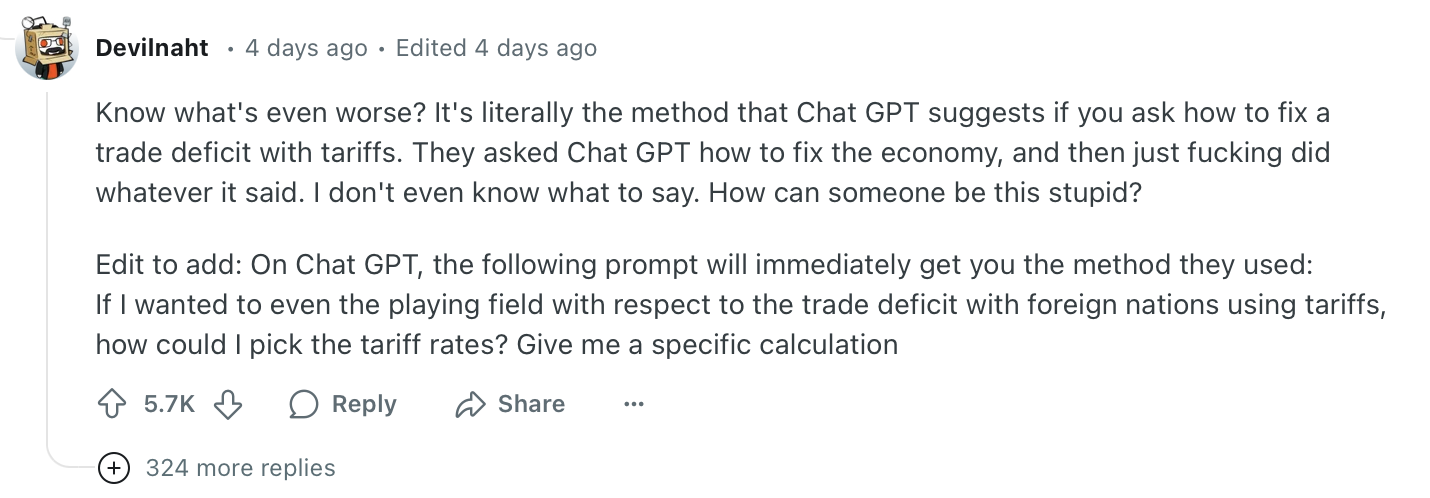
Did a chatbot help shape international trade policy? That’s the question swirling after the Trump administration rolled out sweeping new tariffs — backed by a startlingly simple formula that matches, almost exactly, one generated by ChatGPT. As economists puzzle over the logic behind the moves, a Reddit discovery has added fuel to a provocative theory: in the age of generative AI, are even high-stakes decisions being outsourced to algorithms?

On Wednesday (US time), the Trump administration announced sweeping tariffs on nearly all major US trading partners. Some countries were hit hard, even if they had very small trade deficits with the US. A trade deficit means the US buys more from a country than it sells to them.

Normally, tariffs are set using complex models that factor in global markets, trade negotiations and long-term strategy. But this time, the formula revealed by the Office of the US Trade Representative looked surprisingly basic.

Here’s what they reportedly used:

Tariff Rate (%) = (US Trade Deficit with a Country ÷ Total US Imports from that Country) ÷ 2

To put it simply:

  1. Take the dollar value of the trade deficit.

  2. Divide it by the total value of US imports from that country.

  3. Then divide that number by 2.

A simple example: Country A

Let’s say:

  • US imports from Country A = $100 billion

  • US exports to Country A = $70 billion

  • So, Trade Deficit = $100B – $70B = $30 billion

Now apply the formula:

  1. 30 ÷ 100 = 0.3

  2. 0.3 ÷ 2 = 0.15 → or 15% tariff

So under this method, the US would impose a 15% tariff on all imports from Country A.

But here’s the problem: this formula doesn’t account for some pretty important things, like:

  • Whether those goods are essential for US consumers

  • How the exporting country might retaliate

  • How the new prices would affect American businesses and buyers

That’s part of why economists were stunned. And then, things got even stranger.

The ChatGPT connection

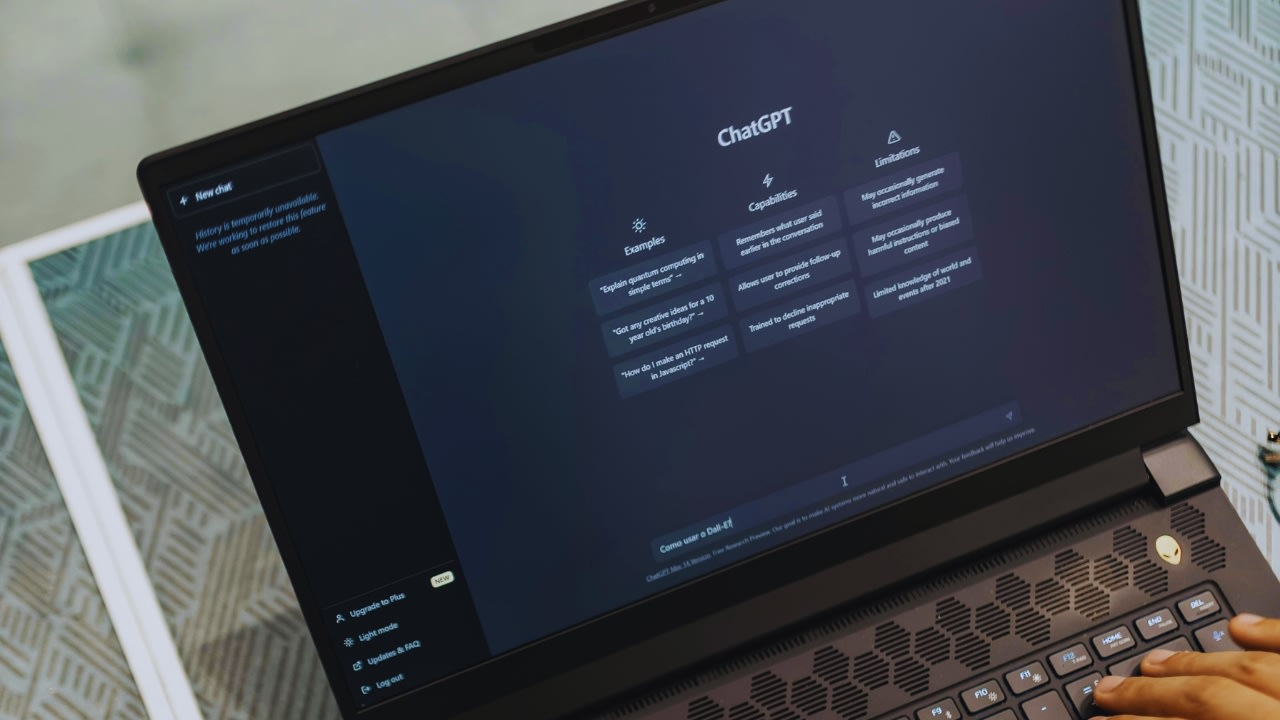
Shortly after the announcement, a Reddit user asked ChatGPT a simple question:

“How should the US calculate a tariff to reduce its trade deficit with a country?”

The answer? Pretty much the exact same formula.
Even the “divide by two” step showed up—without any clear explanation.

Naturally, this raised a few eyebrows. Was someone in government actually using ChatGPT to write trade policy?

Within 12 hours, ChatGPT’s answer had been updated to a more nuanced version that included price elasticity—a measure of how buyers react to price changes. But even then, it still used the “divide by 2” or 50% reduction targetas a central example.

That 50% figure appeared in both the original and updated AI responses.

So… did they really use ChatGPT?

The US Trade Office hasn’t confirmed or denied anything. And we obviously can’t see who, if anyone, inside the government may have used ChatGPT.

But the resemblance is uncanny. And it’s raising some big questions:

  • Are policymakers really just copying and pasting AI-generated content without critical thought?

  • If AI can generate a basic formula, does that mean anyone can make policy now?

One Reddit user joked:

“Why pay an economist six figures when you can just ask a chatbot?”

But there’s a more serious point here.

The real issue

It’s not that AI is bad at maths. It’s that AI doesn’t understand the world.

It doesn’t know that slapping tariffs on allies can lead to trade wars. It doesn’t grasp how a 10% price rise on goods can hurt low-income families. And it definitely doesn’t understand diplomacy, history, or politics.

In this case, using a neat “divide by 2” to aim for a 50% deficit reduction might look logical—but it’s deeply oversimplified.

And applying the same rule to every country ignores:

  • The size of different economies

  • The strategic importance of certain imports and exports

  • Long-term economic relationships

The bigger picture

Even if no one in government literally copied ChatGPT, this incident shows just how tempting AI tools have become for fast, confident-sounding answers.

But policy decisions—especially in international trade—need more than just a clean formula. They need human judgment, nuance and responsibility.

This situation is also part of a wider debate: where do we draw the line between AI support and human decision-making?

As one observer put it:

“There are things humans absolutely should be paid for. And some things that some humans absolutely should not be paid for.”

Read the full conversation here. 

The eerie overlap between ChatGPT and US trade policy may be a coincidence. Or it could reflect a troubling trend—overreliance on automation, even in the halls of power.

Either way, it’s a warning. Because in matters as serious as global economics, no AI-generated shortcut should ever replace expert insight and accountability.

(Special thanks to Mint Kang, our editor at , for her sharp observations on the topic.)

Read full story

Follow on Google News Follow on Flipboard
Share. Facebook Twitter Pinterest LinkedIn Tumblr Email Copy Link

Related Articles

Microsoft applied to hire 6,000 foreign workers just before mass layoffs —

Microsoft applied to hire 6,000 foreign workers just before mass layoffs —

July 9, 2025 Talents
News: 1 million EU auto jobs at risk if 2035 EV target is dropped: Study —

News: 1 million EU auto jobs at risk if 2035 EV target is dropped: Study —

July 9, 2025 Talents
Castrol India appoints Mrinalini Srinivasan as Chief Financial Officer —

Castrol India appoints Mrinalini Srinivasan as Chief Financial Officer —

July 7, 2025 Talents
Eternal announces leadership change, appoints Aditya Mangla as CEO of food delivery business —

Eternal announces leadership change, appoints Aditya Mangla as CEO of food delivery business —

July 7, 2025 Talents
News: 60% of HR consult ChatGPT for layoff decisions: Report —

News: 60% of HR consult ChatGPT for layoff decisions: Report —

July 7, 2025 Talents
Baazi Games appoints Vaibhav Bhandari as Chief Human Resources Officer —

Baazi Games appoints Vaibhav Bhandari as Chief Human Resources Officer —

July 4, 2025 Talents
Top Articles
Accused of fraud, murder, fired exec awarded 0,000, 24 months’ notice

Accused of fraud, murder, fired exec awarded $500,000, 24 months’ notice

January 9, 2024105 Views
5 Best Learning Management Systems in 2025

5 Best Learning Management Systems in 2025

February 11, 202598 Views
Canadian Tire store under investigation for alleged exploitation of temporary foreign workers

Canadian Tire store under investigation for alleged exploitation of temporary foreign workers

October 2, 202498 Views
Stay In Touch
  • Facebook
  • YouTube
  • TikTok
  • WhatsApp
  • Twitter
  • Instagram
Latest News
Museum’s CEO said to have breached federal ethics codes: report

Museum’s CEO said to have breached federal ethics codes: report

staffDecember 11, 2025
Early retirement programs in Canada: how to reduce staff without layoffs

Early retirement programs in Canada: how to reduce staff without layoffs

staffDecember 11, 2025
Collective agreement: Canteen of Canada Food and Vending Services

Collective agreement: Canteen of Canada Food and Vending Services

staffDecember 10, 2025
Most Popular
Alberta appeal panel upholds PTSD claim over threat of sexual violence at work

Alberta appeal panel upholds PTSD claim over threat of sexual violence at work

December 12, 20250 Views
Dec. 12: New leaves take effect

Dec. 12: New leaves take effect

December 11, 20250 Views
Quebec court draws hard line between legal and illegal employee monitoring

Quebec court draws hard line between legal and illegal employee monitoring

December 11, 20252 Views
Our Picks
Museum’s CEO said to have breached federal ethics codes: report

Museum’s CEO said to have breached federal ethics codes: report

December 11, 2025
Early retirement programs in Canada: how to reduce staff without layoffs

Early retirement programs in Canada: how to reduce staff without layoffs

December 11, 2025
Collective agreement: Canteen of Canada Food and Vending Services

Collective agreement: Canteen of Canada Food and Vending Services

December 10, 2025

Subscribe to Updates

Get the latest human resources news and updates directly to your inbox.

Facebook X (Twitter) Instagram Pinterest
  • Privacy Policy
  • Terms of use
  • Advertise
  • Contact Us
© 2025 Human Resources Mag. All Rights Reserved.

Type above and press Enter to search. Press Esc to cancel.