




Close Menu
Human Resources Mag
  • Home
  • News
  • Management
  • Guides
  • Law
  • Talents
  • Benfits
  • Technology
  • More
    • Web Stories
    • Editor’s Picks
    • Press Release
What's On
Quebec, Ottawa invest .7 million in green trades training

Quebec, Ottawa invest $24.7 million in green trades training

March 10, 2026
Beyond the signoff: what Sunwing says about proving real harassment training

Beyond the signoff: what Sunwing says about proving real harassment training

March 10, 2026
Court orders full three-year salary after termination clause gets overridden

Court orders full three-year salary after termination clause gets overridden

March 9, 2026
Facebook X (Twitter) Instagram
Human Resources Mag
Subscribe
  • Home
  • News
  • Management
  • Guides
  • Law
  • Talents
  • Benfits
  • Technology
  • More
    • Web Stories
    • Editor’s Picks
    • Press Release
Human Resources Mag
Home » Speed Traps in Organizations – NOBL Academy
Benfits

Speed Traps in Organizations – NOBL Academy

staffBy staffMarch 24, 20244 Mins Read
Share Facebook Twitter Pinterest Copy Link LinkedIn Tumblr Email Telegram WhatsApp
Follow Us
Google News Flipboard
Speed Traps in Organizations – NOBL Academy
Share
Facebook Twitter LinkedIn Pinterest Email Copy Link

Organizations feel intense pressure to move faster; after all, speed is often not just a competitive advantage, but can be the deciding factor of market dominance. The need for speed is real and often essential. But in your attempt to speed up, beware confusing “speed” for other things:

  • Nostalgia. Some organizations remember a time when they were small and scrappy, and could get things done faster. But growth brings complexity, and coordination and risk management often mean slowing down.
  • Freneticism. Fast-paced, intense work can feel like speed, but doesn’t necessarily result in, well, results. If teams make rapid decisions without considering their impact on the business or objectives beyond “fast,” they can end up far from the original strategy, leaving chaos in their wake.
  • Heroic Efforts. In “fire drill” cultures, teams leap from emergency to emergency, and those who go “above and beyond” are celebrated. This not only leads to burnout, but it often results in organizations losing the ability to do bigger things together because it’s easier and more celebrated to do small, isolated things.

“Speed” is actually a generic term that refers to two distinct concepts: velocity, the rate at which tasks and processes are executed, and agility, the rate at which organizations can adapt and iterate. While velocity and agility share some practices—effective decision making and communication, prioritization, and strong bonds and norms among teammates—they’re often in tension, and organizations that perfect one do so at the cost of the other. 
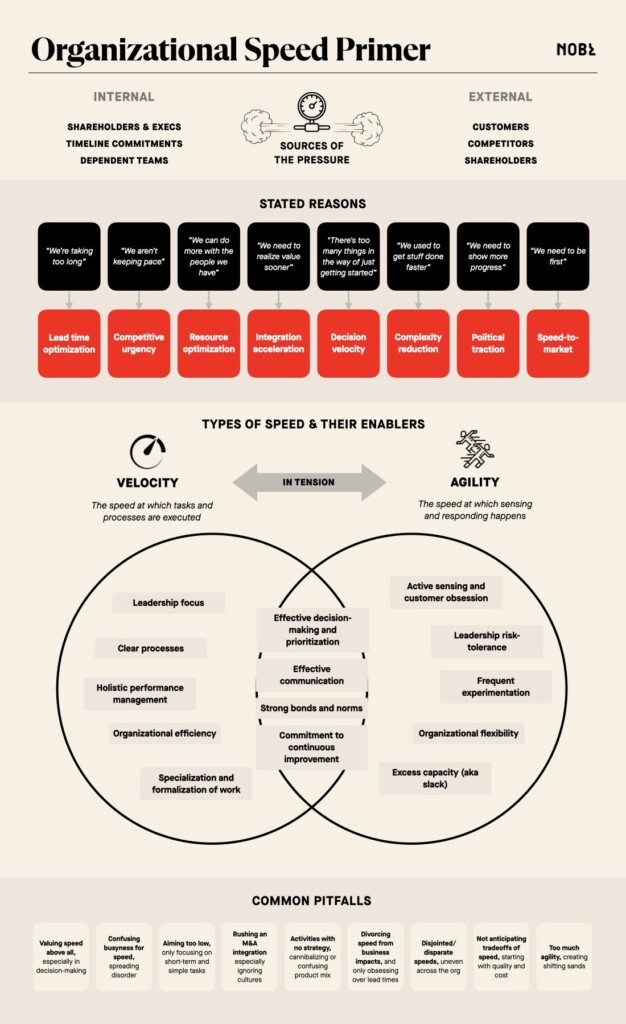
If you’re feeling increased pressure to pick up the pace within your own organization, consider:

  • Why? Where is the need for speed coming from, and is it truly aligned to your market strategy?
  • Which kind? Are you lamenting how long your processes take (i.e., velocity) OR are you wishing your teams could adapt and respond more quickly to market changes (e.g., agility)? Or both?
  • In which areas of the business? Even the fastest organizations on the planet don’t move at the same speed, or for the same reasons, across every discipline or function. Moreover, some teams are more focused on velocity (e.g., physical production) and others agility-obsessed (e.g., marketing). 
  • At what cost? Speed always comes with a tradeoff, whether that’s quality, cost, or even internal alignment. Decide now and make peace with the consequences of speeding up. 
  • With what support? Speed, like any competitive advantage, requires its own unique support: executives with a clear enough strategy to do tricky prioritization, managers smart enough to make decisions quickly without constant escalation, teams staffed adequately enough to focus on a limited number of projects in progress, and tools and rituals to spread information effectively. What do you need to make speed possible?
  • Starting how? Lots of leaders bang the drum for speed, but where will you start so that it’s a lived way of working and not just a demand? Should you pick one project and staff and execute it in a completely new way to try to achieve speed? Maybe isolate one burdensome process to streamline to give every initiative a boost? There’s no single way to get started, but you have to start somewhere.

Avoid Common Speed Bumps

As you get started, keep your eyes out for these all-too-common pitfalls:

  • Valuing speed above all. Leaders can get addicted to speed—especially speedy decision making—and see it as the end-all-be-all, versus what it produces for the organization. Yes, a fast meeting feels good, but make sure the organization is on the way to achieving the outcomes you designated at the start of the change. 
  • Aiming too small or skipping strategy. Smaller projects and less important decisions are easier to do quickly, but they may not have the impact of a larger project that requires a team to work together. Don’t become a “feature factory” or constantly launch new products without understanding what you’re trying to achieve long-term. 
  • Rushing culture. Constant, rapid, and dramatic shifts can leave teams feeling they have no idea where the organization is going. Deadlines don’t always incorporate the time it takes for people to adapt to change. Check in with your teams regularly to ensure they understand what’s going on, and how they need to evolve their working patterns to match.
  • Disjointed teams. While not all teams need to move at the same rate, if one is dependent on the other for a certain output, speeding up one can lead to frustration and backups. Review the processes and communication that connect teams to avoid problems down the line.

Published March 22, 2024
Follow on Google News Follow on Flipboard
Share. Facebook Twitter Pinterest LinkedIn Tumblr Email Copy Link

Related Articles

Mini Experiments: What If Your Job Description Requirements Are the Problem?

Mini Experiments: What If Your Job Description Requirements Are the Problem?

August 15, 2025 Benfits
How HR can adopt gen AI without losing the human touch

How HR can adopt gen AI without losing the human touch

August 15, 2025 Benfits
How to Decide if a Candidate Deserves a Second Interview

How to Decide if a Candidate Deserves a Second Interview

August 15, 2025 Benfits
S&P Global’s employee strategy builds on human talent by investing in their skills and development in AI and beyond

S&P Global’s employee strategy builds on human talent by investing in their skills and development in AI and beyond

August 14, 2025 Benfits
Changes Every Employer Must Know

Changes Every Employer Must Know

August 14, 2025 Benfits
Embracing AI and automation in recruitment

Embracing AI and automation in recruitment

August 14, 2025 Benfits
Top Articles
Accused of fraud, murder, fired exec awarded 0,000, 24 months’ notice

Accused of fraud, murder, fired exec awarded $500,000, 24 months’ notice

January 9, 2024108 Views
5 Best Learning Management Systems in 2025

5 Best Learning Management Systems in 2025

February 11, 2025103 Views
Canadian Tire store under investigation for alleged exploitation of temporary foreign workers

Canadian Tire store under investigation for alleged exploitation of temporary foreign workers

October 2, 202499 Views
Stay In Touch
  • Facebook
  • YouTube
  • TikTok
  • WhatsApp
  • Twitter
  • Instagram
Latest News
Trouble looms as nearly half of employers will soon stop hiring for entry-level jobs: report

Trouble looms as nearly half of employers will soon stop hiring for entry-level jobs: report

staffMarch 9, 2026
RSU termination clauses under scrutiny again

RSU termination clauses under scrutiny again

staffMarch 9, 2026
Ottawa commits .5 million to boost labour market intelligence in key sectors

Ottawa commits $94.5 million to boost labour market intelligence in key sectors

staffMarch 9, 2026
Most Popular
Quebec, Ottawa invest .7 million in green trades training

Quebec, Ottawa invest $24.7 million in green trades training

March 10, 20262 Views
Beyond the signoff: what Sunwing says about proving real harassment training

Beyond the signoff: what Sunwing says about proving real harassment training

March 10, 20262 Views
Court orders full three-year salary after termination clause gets overridden

Court orders full three-year salary after termination clause gets overridden

March 9, 20262 Views
Our Picks
Trouble looms as nearly half of employers will soon stop hiring for entry-level jobs: report

Trouble looms as nearly half of employers will soon stop hiring for entry-level jobs: report

March 9, 2026
RSU termination clauses under scrutiny again

RSU termination clauses under scrutiny again

March 9, 2026
Ottawa commits .5 million to boost labour market intelligence in key sectors

Ottawa commits $94.5 million to boost labour market intelligence in key sectors

March 9, 2026

Subscribe to Updates

Get the latest human resources news and updates directly to your inbox.

Facebook X (Twitter) Instagram Pinterest
  • Privacy Policy
  • Terms of use
  • Advertise
  • Contact Us
© 2026 Human Resources Mag. All Rights Reserved.

Type above and press Enter to search. Press Esc to cancel.