


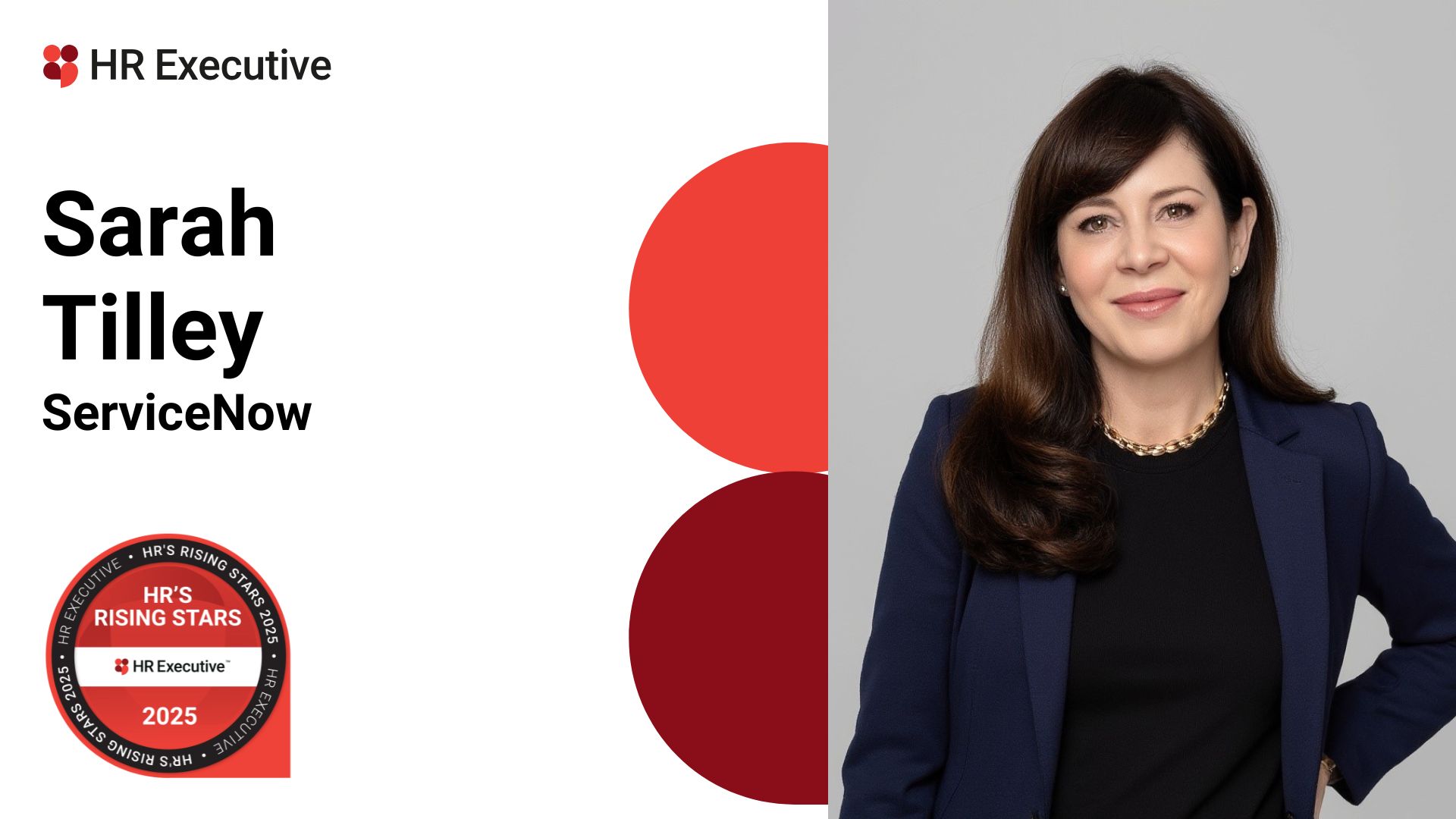
Transforming talent acquisition through AI is at the heart of Sarah Tilley’s work at ServiceNow. Under her leadership, the Fortune 500 company has reimagined how it finds, attracts and evaluates talent by embedding AI-powered tools across the hiring process—without losing sight of the human touch.
As senior vice president of global talent management and acquisition, Tilley has led the introduction of AI to help interviewers craft tailored questions and then measure their effectiveness. Her team uses advanced algorithms to match candidates based on skills and predict future job needs. They also take advantage of AI tools to help create more inclusive job descriptions and continuously audit for hidden biases. Tilley also ensures that data is embedded at every stage of hiring to enhance performance, efficiency and decision-making.
Those accomplishments are among the reasons for Tilley’s recognition this year as one of HR’s Rising Stars. Her efforts have helped elevate talent by improving employee and candidate experience, contributing to a time of revenue growth at ServiceNow.
“We have this opportunity for a human renaissance,” Tilley says. “Taking away a lot of the mundane, repetitive, transactional work frees us up to bring the most human things of ourselves to the table—the things that only humans can uniquely do.”
Tilley embodies a new wave of HR leadership. As a member of the 2025 class of Rising Stars, she operates at the intersection of human resources and enterprise technology—where AI is rapidly reshaping traditional practices and redefining the future of work.
Tilley has been with ServiceNow for over three years, following more than two decades of talent acquisition experience at entertainment giants Warner Bros. and The Walt Disney Company. Still, she says, the work she’s doing now may be the most monumental of her career.
When asked about her proudest accomplishment at ServiceNow, Tilley points to “what’s happening in this moment,” referring to how her team is harnessing AI to shape the organization’s approach to talent acquisition.
Related: Meet all of the 2025 HR’s Rising Stars
Rather than replacing human capability, she positions technology as a tool for enabling deeper human connection and smarter decisions. This thoughtful approach required a plan that she and her team could scale throughout the workforce. Under her leadership, ServiceNow launched its comprehensive “AI-First Talent Strategy.”
This effort includes updating all job descriptions to reflect AI-related skills, requiring recruiters to evaluate candidates on basic AI competencies and developing a proprietary skills intelligence platform to support employee growth.
Outcomes of an AI-first talent strategy
The impact of the “AI-First Talent Strategy“ has been significant:
- 163% increase in AI-focused job postings (1,200-plus positions year-to-date)
- 4-5x increase in employees with AI skills and experience over the past two years
- A record 1.6 million applicants in 2024 (vs. about 1 million in 2023 and around 700,000 in 2022)
- 18,000-plus hours saved annually through AI-powered HR support systems
“With the traditional ways of [acquiring talent], we’ve been able to do some really highly effective things,” says Tilley. “But you still have a lot of recruiters spending time on administrative tasks rather than strategic hiring decisions. All of that is changing with AI.”
One of Tilley’s most forward-thinking strategies is replacing conventional hiring criteria with skills-based assessments. Instead of focusing on formal education, previous job titles or experience, ServiceNow identifies the exact skills—and level of expertise with those skills—required for a role. “Now, we can get a lot more specific, a lot more precise,” she says.
Tilley’s AI implementation also prioritizes transparency and personalization in candidate communication. “There’s nothing more frustrating than the waiting game,” she says. “We have the ability with AI to not rely on an action being taken by a recruiter in order to generate that level of communication [and] update transparency, and we have a way to personalize it.”
What is the four E framework?
In addition to her work in talent acquisition, Tilley’s approach to talent management and development is anchored in her “four E framework” for internal mobility: Education, Exposure, Expectations and Experiences. The model supports formal learning opportunities; fosters connections between new hires and their teams, leaders and mentors; sets clear growth pathways with defined metrics; and provides hands-on experience through new roles and projects, she says.
Her goal is to help people gain experience through internal projects or formal moves into new roles—whether upward or lateral—while ensuring they have access to suitable opportunities. “There’s no substitute for actually doing something,” Tilley says.
The impact is clear: Internal hires now make up 29% of total recruitment, employee engagement sits at 82% (above the software industry benchmark of 72%, according to data from CultureAmp), and retention is strong, with fewer than one in 35 top performers leaving in 2024.
This year, ServiceNow launched an AI learning framework that offers training, upskilling and hands-on experience for every role. Through its new AI-powered learning platform—ServiceNow University, which was advanced by Tilley—the company aims to reach 3 million learners—including employees, customers, partners and individuals—by the end of 2027.
Tilley is especially committed to developing early-career talent and champions redesigning roles to better match emerging talent with business needs, ensuring new employees can quickly build new skills while contributing in meaningful ways. “I honestly believe that the companies that continue to invest in early-career talent are going to win,” she says. “They’re the future of corporations.”
Experiences that solve problems
Gregory Hessel, managing director of client development at Korn Ferry, says Tilley’s 25-year career has been anchored by roles at companies that are well-known for developing “operationally minded” HR leaders.
“In her current role at ServiceNow, she and her team are laser-focused on elevating the full talent cycle from recruitment to succession,” says Hessel. “Their AI-driven work is forward-leaning and provides a true competitive advantage in talent.”
One of Tilley’s key innovations is reimagining HR as a product organization: “We are designing experiences from the get-go that solve real problems for people,” she says. This approach involves asking, “What is it that’s going to move the needle the most in terms of what people care about?”
Tilley and her team “reverse engineer” solutions based on the answers to the question above and other thoughtful inquiries.
How AI is driving company success
A solid partnership with legal, compliance and tech departments ensures that HR technology, including AI initiatives, is indeed delivering something that the business cares about, she says.
Tilley’s leadership during ServiceNow’s period of rising profitability, resulting in 22.5% year-over-year revenue growth as of Q2 2025, demonstrates her ability to scale operations while maintaining quality. “I’m really proud of how my team has leaned in with curiosity and optimism and support and is thinking creatively and openly,” she says. Her team’s influence has led to impressive retention of top talent—in 2024, fewer than one in 35 top-performing employees left ServiceNow, according to company representatives.
At ServiceNow, AI is intended to empower humans, Tilley says. This applies to the firm’s 26,500 employees as well as its customers, which include more than 500 customers with contracts valued at over $5 million. “[AI] is here to unleash our potential, to make our relationships better,” she says. “If we embrace [AI] for the good and see how it’s going to allow us to make better decisions and bring the things that are uniquely human to the forefront, then it’s a win.”
Tilley and the other 2025 HR’s Rising Stars will be honored during the inaugural HR Icons Awards Evening, taking place Sept. 15 at Mandalay Bay in Las Vegas as part of the HR Tech conference.