




Thank you! A team member will reach out shortly.
Incentive theory offers valuable insights into what drives employee motivation in the workplace. It encourages people to strive for goals by offering rewards that feel meaningful and relevant. Whether it’s a financial perk, professional growth opportunity, or simple recognition, incentives help create a culture where employees feel valued and motivated to contribute their best. By applying this theory, organizations can create systems that align employee motivation with company objectives.
In this blog, we’ll explore how incentive theory shapes workplace strategies and the impact it has on employee engagement and performance.
What is incentive theory?
Incentive theory explains how external rewards motivate individuals to perform specific actions or achieve goals. It suggests that behavior is driven by the desire to gain rewards or avoid negative outcomes. These rewards can be tangible, like bonuses or promotions, or intangible, like recognition or praise. The theory highlights the importance of aligning incentives with what individuals value to maximize motivation and performance.
The history of incentive theory
Incentive theory is based on the idea that people are motivated by rewards. This theory suggests that individuals will act in ways that lead to positive outcomes or avoid behaviors that result in negative ones. The roots of incentive theory trace back to early psychological research in the 20th century.
In the mid-1900s, psychologists like Clark Hull and B.F. Skinner explored the relationship between behavior and rewards. Hull’s drive theory focused on how biological drives, such as hunger, lead to actions aimed at fulfilling those needs. Skinner’s work on operant conditioning further advanced the idea, emphasizing how reinforcement strengthens behavior.
Over time, the theory evolved. The idea shifted from focusing solely on physical needs to including social and psychological rewards, such as recognition or praise. Incentive theory today recognizes that motivation comes from a combination of intrinsic factors, like personal satisfaction, and extrinsic rewards, like money or bonuses.
What motivates people in the workplace?
People in the workplace are motivated by factors that meet their needs and align with their goals. This can be broken down in two ways:
Positive motivators
- Financial rewards: Bonuses, raises, and stock options provide tangible benefits for achieving goals or exceptional performance.
- Recognition: Public acknowledgment, awards, or praise for contributions boosts morale and reinforces positive behavior.
- Professional growth: Opportunities for training, education, or career advancement help employees achieve personal and professional aspirations.
- Work-life balance perks: Flexible schedules, additional vacation days, or wellness programs enhance overall satisfaction.
- Team support: Collaborative environments and strong relationships foster a sense of belonging and motivation.
Negative motivators
- Avoiding penalties: Missing deadlines, loss of privileges, or reduced responsibilities motivate employees to meet expectations.
- Job security concerns: Fear of job loss or demotion encourages employees to maintain performance levels.
- Performance reviews: Constructive criticism or lower ratings push individuals to improve skills or outputs.
- Competition pressure: Fear of being outperformed by peers can drive increased effort and focus.
- Compliance requirements: Adherence to rules or policies prevents disciplinary actions or reputational damage.
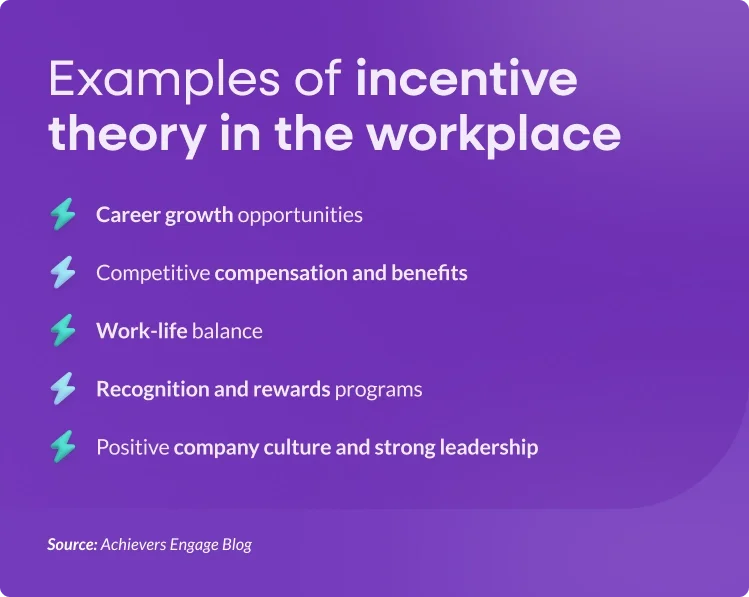
Examples of incentive theory in the workplace
The following incentives address both tangible and intangible aspects of employee satisfaction, contributing to a work environment that supports long-term retention:
- Career growth opportunities: Offering clear paths for advancement, coaching or mentorship programs, or skill development keeps employees engaged and shows them they have a future within the company. This investment in their development can reduce turnover by fostering long-term loyalty.
- Competitive compensation and Benefits: Regularly reviewing salaries, providing comprehensive benefits packages, and offering perks such as health insurance, retirement plans, and stock options demonstrate the company’s commitment to employee well-being and financial security.
- Work-life balance: Flexible work arrangements, such as remote work options, flexible hours, and additional paid time off, can greatly improve work-life balance, reducing burnout and making employees feel valued beyond just their productivity.
- Recognition and rewards programs: Consistent recognition through rewards and recognition programs, whether monetary, non-monetary, or peer recognition, helps employees feel appreciated and reinforces a culture of respect and acknowledgment.
- Positive company culture and strong leadership: A supportive and inclusive company culture, paired with empathetic and transparent leadership, creates an environment where employees feel connected, respected, and motivated, making them more likely to stay with the company.
How to use incentive theory to motivate employees
Incentive theory helps organizations understand how rewards can motivate employees to achieve their goals. By offering meaningful incentive programs, businesses can boost engagement and productivity. Here’s how to apply the theory effectively:
- Set clear goals: Define specific, measurable objectives and key results (OKRs) for employees to work toward.
- Offer relevant rewards: Choose incentives that align with employee values, such as bonuses, promotions, or professional development opportunities.
- Provide immediate feedback: Recognize behaviors and achievements promptly to reinforce positive behavior.
- Use a mix of motivators: Combine financial, non-financial, and recognition-based incentives for a balanced approach.
- Evaluate and adapt: Monitor results and adjust incentives to ensure continued effectiveness.
The key components of incentive theory
Incentive theory explores the factors that drive human behavior through external influences. It focuses on key components such as rewards and punishments, along with intrinsic and extrinsic motivation. These elements help explain how different types of incentives impact actions and decisions.
Below are the key components of incentive theory that shape how individuals are motivated in various contexts:
Rewards and punishments
Rewards and punishments are central to incentive theory because they directly influence behavior. A rewards system encourages positive actions by offering desirable outcomes, such as bonuses, promotions, or recognition. Punishments, on the other hand, discourage negative behaviors by imposing undesirable consequences, like penalties or reprimands. Together, rewards and punishments shape how individuals respond to different situations, driving them to achieve desired results or avoid mistakes. Understanding how these elements work within a reward system can help create effective motivation strategies in the workplace or other settings.
Rewards and punishments
Intrinsic and extrinsic motivation are at the core of incentive theory and play a big role in shaping how we act. Intrinsic motivation comes from within — it’s the drive to do something because we find it personally rewarding or enjoyable. Think of it like tackling a project just because it excites you or gives you a sense of belonging or accomplishment. On the other hand, extrinsic motivation relies on outside factors like rewards, recognition, or money. It’s the kind of push that helps you meet deadlines or hit targets. Both types of motivation are powerful and understanding them can help businesses create strategies that truly inspire their teams.
The challenges of incentive theory
Incentive theory can be challenging to apply effectively. For example, imagine a company offers employees bonuses for meeting sales targets. While this extrinsic reward may motivate some employees to work harder, it might lead others to focus only on short-term goals, neglecting long-term relationships with customers. Alternatively, an employee who is intrinsically motivated to help others may feel demotivated if the company ignores non-financial rewards like recognition or career growth opportunities.
Balancing intrinsic and extrinsic motivators while aligning them with company goals can be tricky and requires careful planning to avoid unintended outcomes such as:
- Short-term focus: Incentives like bonuses may encourage employees to prioritize immediate results over sustainable, long-term success.
- Unintended behaviors: Employees might exploit systems or cut corners to achieve rewards, undermining company ethics or quality standards.
- Overemphasis on extrinsic rewards: Relying heavily on financial incentives can overshadow intrinsic motivators, reducing overall engagement and satisfaction.
- Demotivation of intrinsically motivated employees: Employees who value personal growth, recognition, or teamwork might feel undervalued if incentives don’t align with their priorities.
- Equity concerns: Perceived unfairness in the distribution of rewards can lead to resentment and a decrease in morale.
- Cost sustainability: Maintaining generous incentive programs can strain budgets, particularly if rewards aren’t tied to measurable business outcomes.
- Inflexibility: Standardized incentive structures may not cater to diverse employee needs or motivations, limiting their effectiveness.
- Goal misalignment: Poorly designed incentives can inadvertently steer employees away from broader organizational objectives.
- Reward habituation: Over time, employees may come to expect rewards, diminishing their motivational impact.
- Measurement challenges: Accurately tracking performance metrics and attributing it to specific actions can be complex, leading to disputes over rewards.
Leveraging incentive theory for personal and professional development
Understanding and applying incentive theory can significantly drive both personal and professional growth. By leveraging rewards and motivation effectively, organizations can foster a more engaged, productive, and satisfied organizational culture.
Integrating a rewards platform can elevate company culture and encourage long-term success for both individuals and teams. Achievers offers a platform that aligns perfectly with these principles: Achievers RewardTM. This program provides a variety of incentives to recognize employee efforts and motivate continued growth. With tools that support both intrinsic and extrinsic motivation, Achievers ensures that employees feel valued, engaged, and empowered to reach their full potential.


In this article: